Sunday, 12 January 2014

blog 10

PPD1 blog 10
This is the final blog entry for PPD1. This blog will show my high level exit plan and my justification for what I have included for my ‘blockout’ show reel. These are important as they are the biggest factors of how I will get a job in the industry.

Self-promotion
To promote myself, I will include a show reel showing my best work, I will also use the work I did on the computer game (Super Collateral) I worked on in university as it is actually a game project. I will do work online in the form of tutorials by keeping posts on my blog, also do video showing how to do 3d rigging on sites such as “YouTube” and also I will include videos of my best work on my portfolio. Another way I plan to promote myself is my CV and animation created from using my rigs. I also plan to look at freelance and work for free in order to meet and gain experience from people in the industry.
My block out show reel
My blockout show reel shows what I have included and what I plan to add. In order to help give me an idea of what a show reel should look like, to start off with I looked at show reels of 3d rigging and animation online. Also I managed to get into contact with a 3D rigger at one of the longest running video game companies “Rare Ltd”; who gave me a list of what I should include in my show reel. Below shows the email conversation I had with (email address has been edited for privacy issues)


The email shows me what I should include in my show reel, in my block out it shows my rigs working. She said show scripting abilities which at the moment I’m not sure how to go about. It says sound a good understanding of anatomy which is why I plan to include a muscle flexing rig. It also says include realistic animals.
What I have learnt
From doing this module I have learnt a lot about the industry, in particular where it started and what it’s like now. I also learned about what to do in an interview. The most important elements I have learned is making a portfolio and show reel.
Here is a link to my block out show reel.

blog 9

PPD1 Blog 9
In this lecture for PPD1 we actually had a 3rd year student who has had experience in the industry. He talked about how he got insider knowledge from people he knew in the industry. He sent his CV and portfolio to the recently closed down “Eurocom” in Derby; however he waited a long time before he got a reply, while waiting he sent his portfolio to a non-games company and also applied to the games company “Blitz”, who offered him his first interview.
  

The image above is the logo for the games company “Blitz” from http://blogs.warwick.ac.uk/images/vgdsoc/2005/10/13/blitzgames.jpg
At “Blitz” he had to do two interviews, the first one consisted of Q&A when they asked him about his portfolio; one of the questions he was asked was about his experience with game engines, he spoke about the “Naughty Dog” game engine saying he liked its lighting. He did a second interview, at which he had to do a two day art test, which consisted of filling a gap between two buildings. Unfortunately he didn’t get the job.
   

The image above is the “eurocom” logo from http://www.mobygames.com/images/i/11/44/500644.jpeg
After “Eurocom” got back in touch with him; for this he only had to do one interview which was Q&A however because he was more prepared for the interview it was a lot easier and he demonstrated his knowledge of the company by stating the games he liked which they have made. As a result he got a job there. To start off with at “Eurocom” he had to do collision for about 3 months, but eventually he was able to make props and work on “Transformers” for “Jagex”. However eventually “Eurocom” closed down and he could no longer work there as the company went into liquidation. But still by working there that he made a lot of contacts in the industry and realised how easy it was for game companies to run into difficulties and eventually close down. 
What I learned 

By seeing this interview I learned how important it was to be prepared for an interview. I also found out that by making contacts in the industry you can increase your chances of getting a job. I also found out about how easy it can be for a company who seem to be doing fine can close down very quickly. I planned to use what I have learned by making more contacts by looking at forums where people in the industry post blogs there.   

blog 8

PPD1 blog 8
In this week of PPD1 we had a guest lecture Ray Shum, an environment artist, who has worked on games such as “Project Gotham racing 4” and the recent popular game “GTA IV” by “Rock Star”.

 Here is a link to his portfolio http://www.rayshumdesign.co.uk/.
He talked about getting into the industry by finishing his degree; to begin with his first job wasn’t in the games industry. The first game company he worked at was the recently closed down “Bizarre Creations” from the year 2005 till 2009. He worked on games such as “Project Gotham Racing 3” and “Project Gotham Racing 4”. After “Bizarre Creations” he worked as a freelance web designer. The second games company he worked at was “Rock Star” from 2010 till 2013 where he worked on the game “GTA IV” one of the biggest selling games ever.    
He then showed us his portfolio. After he showed us the work he did on “GTA 5”, namely the building he designed and how he used modular pieces in order to bring them together.
What I learned

By going to this lecture I learned how important it is to work on your portfolio, as it is the main thing that gets you into the industry. I know you should always include your best work first; by looking at his CV I saw the work experience he had, I plan to us the work experience I have on the game I have made in a team in order to show I’m capable of working on a game.           

blog 7

PPD1 blog 7
In this week we had another opportunity to practice being interviewed. To start off with we looked at things to consider for an interview.
Working in a team is very important in the game industry because there are so many different job roles in the industry that need to come together, and communicating with others like programmers who create code for your assets in the game. You may need something produced for a certain time and so you need to be able to communicate the requirements. Decision making in an interview is important as you may get things to turn more in your favour, however you need to be careful as you might decrease you chances of getting a job. You need to make you communication as clear as you can in order for the interviewer to know what you saying and also for you to know what they mean.  You should be assertive to show confidence but not too much as you might scare them off. You’re negotiation skill needs to be in check in order to get to best deal you can. This too is important and it helps to have good leadership skills in case you get promoted to a leadership position after a few years into your job. Finally time management is very important as you will need to be able to meet deadlines.
While doing the interviews we needed to apply for what real jobs are out there in the industry. I found a job opening at “Pixel Bomb Games” located in Manchester.


During the interview, I felt very confident and spoke of my experience doing 3D rigging for my game project at university, I spoke about minor problems I had about making the rig compatible for the game engine. I also spoke about working as a team player and how I felt about it, I spoke very honestly about problems I had working in a team and how I was able to resolve the issues so that it got better and was sorted really quickly. I had problems talking about projects they carried as they seem to be a new company and so was unable to get a lot of information about them.
What I learned

By doing this again, I felt that by being more confident and knowing more of the things to say, it went better. However I did have problems as the company still hadn’t finished their first project yet so I couldn’t talk about why I would like to work there. The reason for this was there didn’t seem to be many job ingsopen for 3D rigging. To get past this I changed my skill set to “Rare LDT” which I knew quite well and the interview went much better. The biggest struggle for me was when my tutor started recording me and I felt under pressure, and so I struggled to speak about games they produce and why I liked them; because of this I realised how much harder it would be in an actual interview with someone I didn’t know and that it probably would be recorded. This has taught me a valuable lesson and I plan to work on my confidence while preparing for an actual interview.             

blog 6

PPD1 blog 6
In this week’s lecture we learned about planning a show reel. A show reel is one of the biggest factors of getting a job in the industry as it shows how good you are and what you can provide for a company.
Here is what I think is a good 3D rigging show reel     
In my opinion the reason for why it is good is because it shows animation working with the rig and also it shows it working within a scene, and demonstrates is it very quick, showing good work. The bad points I would say are the intro which is delayed too much. Another criticism is even though it is a rigging and animation show reel, it mostly shows animation and only a small amounts of rigging.
Here is an example of a bad show reel
In my opinion this is a complete failure, the intro is too long, after which it shows a 3d model which isn’t in my opinion very good; it is basic and the texture is not good quality which causes the show reel to suffer visually. The music is more of an annoyance as it does not suit the show reel. It just shows rig after rig and doesn’t show animation working with the rig. I also felt the rigs inside were very basic to the point where everything shown in the rig was the same as I had learned in the second year when doing 3d rigging. The biggest problem of all was it was over 12 minutes long and I couldn’t stand watching it as I had already lost interest after the overly long intro. If a company looked at this I wouldn’t imagine they would watch it past the intro let alone 12 minutes of basic rig after basic rig.
From watching these two it has helped me to establish what to include in my planning for my show reel
The first part of this lecture are project goals, the sector who receive my portfolio in rigging is the game and animation industry from people that are artists, human resources, producer/management and Q A. The portfolio will first need research behind it; to start you will have to find out what they want from you? For example,  are you capable of their project needs. You will need to know what games they make as you will need to show you can work for them. You will benefit from finding out who works there so you can see what their portfolio looks like as it will indicate how they got a job there.                
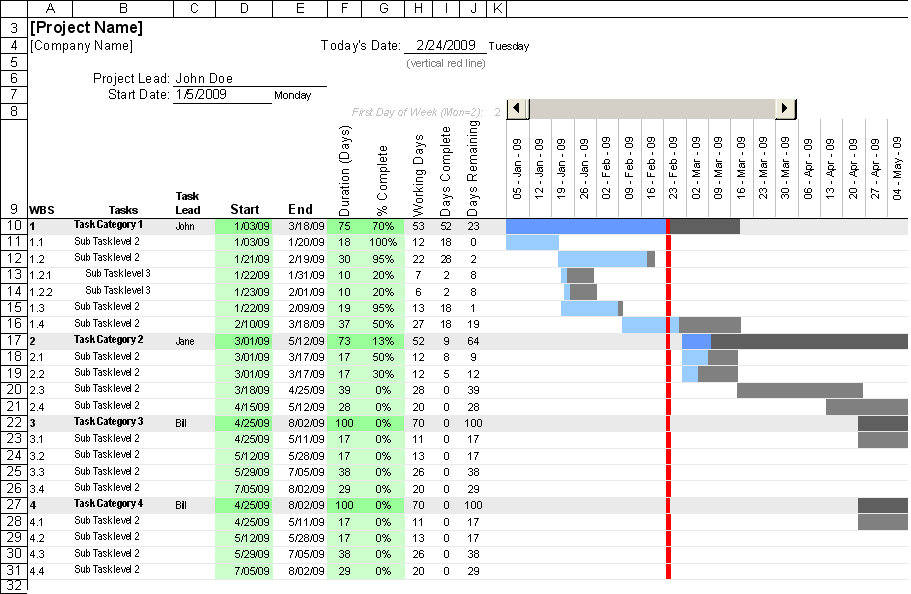
We also look at planning project most likely using a gantt chart. Here is an example from the image below from http://images.vertex42.com/ExcelTemplates/excel-gantt-chart-MF_large.gif


Creating a gantt chart will help you make deadlines by a certain date, by seeing how many hours/days you work on a project and when either you or a team will complete it. Before you make it you will have to ask yourself if the project is realistic or not as you may have planning problems you may encounter ahead.

What I have learnt

From hearing this lecture I have learned the important of planning plus the dos and don’ts of making a show reel. Do not make it overly long as the viewer will potentially lose interest; around one to two minutes would be best, only focus on one or two areas as you don’t want to overcrowd it as it will cover too many different jobs and areas. Always show your best work first as it will keep them watching, also make it work without music as there may just be looking at it without speakers or head phones. I plan to include what I have learnt in my show reel. 

Blog 5

PPD1 blog 5
This week in PPD1 we review on how the interviews went and we got feedback on how we did. We thought about what we learned, how well we presented ourselves while being interviewed and also the same about being the interviewer.
From looking at the feedback I got it said I showed I was very passionate about 3D rigging. It also said my eye contact was good, a showed confidence and appear very friendly. The feedback said I had good body language. On articulation it said I had a good response time as well as showing a good understanding of 3D rigging; it also said I showed honesty. However some of the problems I had were some of my answers were short.
On my salary expectations I said I was hoping for just an entry level wage and in a few years I was hoping to get a better wage and it was very realistic.
On my strengths I felt I showed a good knowledge of the area and also I was always willing to learn more. I felt that the advantages I had over others was I was just as good as someone more experience and that I was cheaper. The software I have knowledge and experience was a lot in “Autodesk Maya” a bit less in “3D studio max. I also have experience in “Photoshop”, in terms of game engines a have a lot in “UDK” and brief experience in “Unity”.
On my weakness I would like to improve on, the first being my bad skills at project management as I find I hard to lead. I also feel that I feel uncomfortable working in groups however since being at uni I have gotten more use to working with other people and that it is starting to become less of an issue.
When looking at positive element of myself I feel that I am hard working and always am willing to learn.
What I have learned

From looking at this reflexion, I have learned how important it is to research game companies before doing an interview as it shows that you are a fan of the company and are either to work there. While my feedback was mostly positive I felt there were a lot of elements I could improve upon that the note taker didn’t not down; like the animal question which I said I would be a stag because it was elegant and free, while other people came up which better answers like an ant as it very good at working in a team.       

Blog 4

PPD1 blog 4
This week we learnt a very important part of getting a job interview. Job interviews are vital as a company will want to get to know you and know if you will be good to hire.
To start this we got into groups of three, one taking the role of the interviewee, someone else taking the part of the interviewer; and the last person being a note taker to see what was good about the interviewee and what was bad. After 10 minutes we changed the order.
We each had to ask a fixed set of questions and then questions of our own. We were doing this to see how each of us coped with the interview.
The setting for the interview was getting an interview from the company “Mind candy” based in “Shoreditch” famous for creating “Moshi Monsters”. The qualities for the job were someone who was creative and ambitious. However the people needed to have a quick edge positive attitude.
      
                       
The image above show the “Moshi Monsters” franchise it is from the website  http://www.gbposters.com/images/originals/0002/7149/FP2612-MOSHI-MONSTERS-landscape.jpg
What I learnt

By doing the interview I had a taste of what it would be like to be interviewed, however I do realise that a formal interview with a company would be more difficult and have harder questions to answer. I did learn though that you cannot expect a big salary without any experience in gaming industry, however you can use what you have achieved at university as way of getting a better chance, not with the wage but getting in. I also found that I was struggling with some of the questions, I struggle because I wasn’t prepared, showing how important it was to ready you self for an interview. I planned to use what I have learnt if I get an interview by preparing and doing research of the company as I also find out by looking like a fan it shows you would be willing to work hard if you got a job in the company.